



Introduction
When economic uncertainty strikes and traditional markets stumble, investors instinctively seek shelter in safe haven assets. For thousands of years, gold has reigned supreme as the ultimate wealth preservation tool, surviving financial collapses, political upheavals, and currency crises.
Now, in our digital era, cryptocurrency has emerged as a modern alternative. This comprehensive comparison examines both assets’ historical performance, core characteristics, and viability as safe havens in today’s volatile economic landscape.
The Historical Pedigree of Gold
Gold’s reputation as a reliable store of value isn’t accidental—it’s the result of centuries of market evolution and global trust. Understanding this historical foundation helps explain why gold remains relevant in modern portfolios.
Gold’s Millennia-Long Track Record
For over five millennia, gold has served civilizations as both currency and wealth preservation tool. Unlike government-issued money that can be printed endlessly, gold’s scarcity is naturally limited. Its unique physical properties—resistance to corrosion, easy divisibility, and universal recognition—have made it the go-to asset during hyperinflation, conflicts, and political crises.
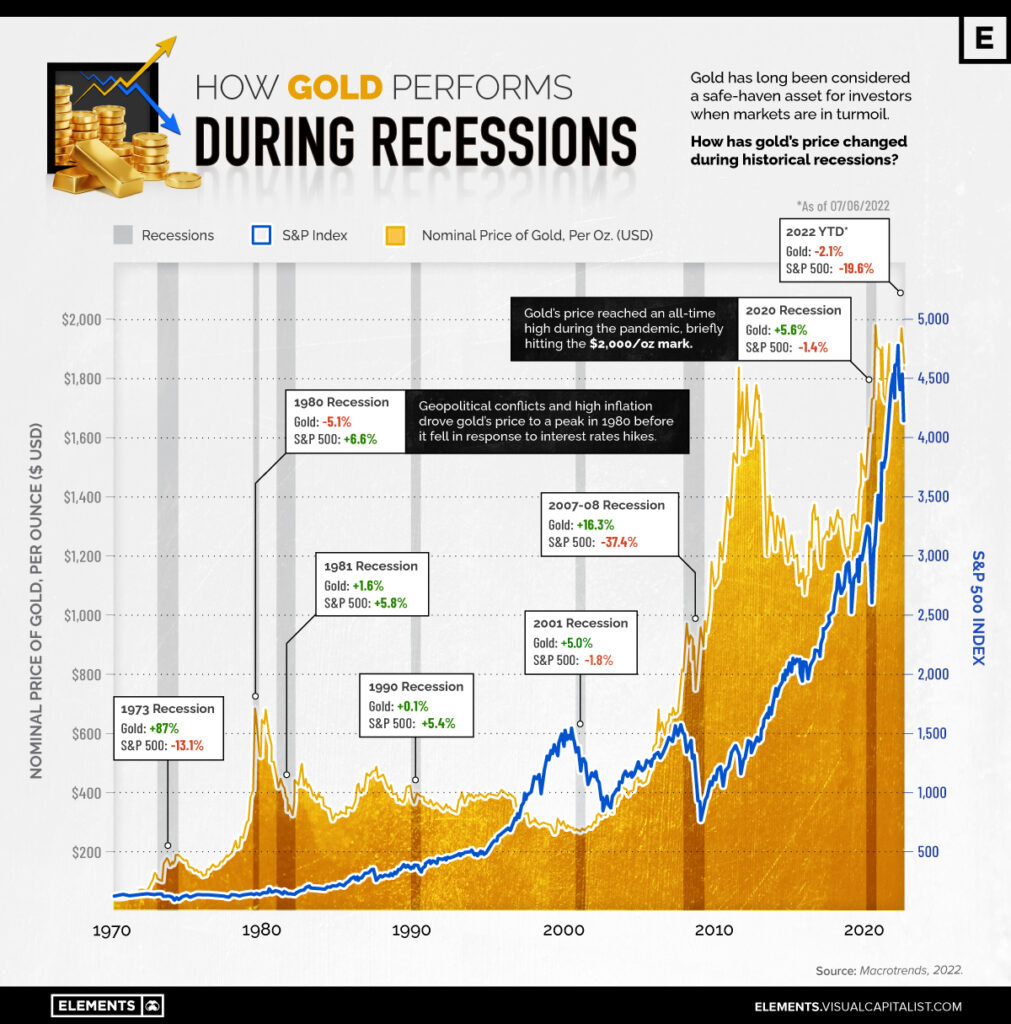
This extensive history provides confidence that no contemporary financial instrument can replicate. Gold’s performance during major economic disasters demonstrates its resilience. Federal Reserve research confirms that during the 2008 financial crisis, while the S&P 500 plummeted over 50%, gold prices climbed approximately 25%. Similarly, throughout the high-inflation 1970s, gold generated annual returns exceeding 30%, dramatically outpacing inflation.
Performance During Modern Financial Crises
Gold’s durability became particularly evident during the 2008 global financial meltdown. As Lehman Brothers failed and credit markets seized, gold initially dipped alongside other assets as investors scrambled for cash. However, it rapidly recovered and entered a sustained bull market as central banks worldwide launched massive quantitative easing programs.
More recently, during the COVID-19 market crash of March 2020, gold again proved its safe-haven qualities. Federal Reserve data indicates that after a brief liquidity-driven decline, gold prices soared to record highs as investors sought protection against enormous government stimulus measures.
The Rise of Cryptocurrency as a Digital Safe Haven
While gold represents physical scarcity, cryptocurrency embodies digital scarcity—a concept gaining substantial traction among younger investors seeking alternatives to traditional financial systems.
Bitcoin’s Origin Story and Philosophy
Bitcoin emerged in 2009, immediately following the 2008 financial crisis, with a philosophical foundation rooted in skepticism toward centralized financial power. Its mysterious creator, Satoshi Nakamoto, embedded in Bitcoin’s first block a timestamp referencing a bank bailout headline, signaling its purpose as an alternative to conventional banking.
The fixed supply of 21 million coins creates digital scarcity that advocates argue surpasses gold, whose supply grows annually through mining. The underlying blockchain technology delivers transparency, security, and decentralization—features that appeal to those concerned about government overreach.
Crypto Performance During Recent Turbulence
Cryptocurrency’s behavior during economic stress has proven more complex than gold’s. NBER research on cryptocurrency volatility shows that during the March 2020 COVID crash, Bitcoin initially mirrored risk assets, plunging over 50% within days. However, it subsequently launched one of its most impressive rallies, ultimately reaching unprecedented highs.
In nations experiencing hyperinflation or capital controls—including Venezuela, Argentina, and Nigeria—cryptocurrency adoption has skyrocketed as citizens struggle to preserve wealth. Chainalysis reports position Venezuela among global adoption leaders, with peer-to-peer Bitcoin trading volumes surging during currency collapses.
Fundamental Characteristics Comparison
Examining the core attributes of both assets reveals why they attract different investors and serve complementary roles in diversified portfolios.
Characteristic
Gold
Cryptocurrency
Physical Form
Tangible, physical asset
Digital, intangible asset
Supply Dynamics
Limited but increasing (~2% annually)
Algorithmically fixed (e.g., Bitcoin’s 21M cap)
Storage & Security
Requires physical storage/insurance
Digital wallets, private keys
Transaction Speed
Slow physical transfer
Near-instant global transfers
Regulatory Status
Well-established regulatory framework
Evolving, uncertain regulation
Historical Track Record
Millennia of established value
~15 years of price history
Inflation Hedge Efficacy
Proven long-term inflation hedge
Emerging inflation hedge characteristics
Institutional Adoption
Widespread institutional acceptance
Growing but limited institutional uptake
Scarcity and Supply Dynamics
Both assets derive substantial value from scarcity, though the nature of that scarcity differs fundamentally. Gold’s scarcity is physical and geological—while new gold is mined annually (increasing supply by approximately 1-2% according to USGS gold production data), the total above-ground stock remains finite and costly to extract.
Cryptocurrency scarcity, especially Bitcoin’s, is mathematical and predetermined. With a fixed supply cap of 21 million coins and predictable emission schedule, Bitcoin offers absolute scarcity unalterable by human intervention.
Storage, Security, and Accessibility
The practical aspects of owning and securing these assets present dramatically different challenges. Gold, being physical, requires secure storage solutions like bank vaults, specialized depositories, or home safes—each involving costs and insurance considerations.
Cryptocurrencies, being digital, can be stored in various wallet types, from convenient exchange accounts to more secure hardware wallets. While digital storage eliminates physical security concerns, it introduces new risks including exchange hacks and lost private keys.
Risk Analysis and Volatility Assessment
Every safe haven carries unique risks. Understanding these risk profiles is essential for informed investment decisions.
Price Volatility and Market Maturity
Gold’s price history features extended stability periods interrupted by significant moves during crises. Its annual volatility typically ranges between 15-20%, making it considerably steadier than most equities and dramatically less volatile than cryptocurrencies.
Cryptocurrencies, conversely, are notoriously volatile, with Bitcoin regularly experiencing daily price swings of 5-10% and annual volatility often surpassing 80% according to Bloomberg data.
Regulatory and Technological Risks
Gold operates within a well-established regulatory framework developed over centuries. Ownership rights are clearly defined, and international markets function with high liquidity and price transparency. The primary regulatory risks for gold involve potential government confiscation, though these remain relatively low probability in most developed nations.
Cryptocurrency faces a much more uncertain regulatory landscape. Governments worldwide are still determining how to classify, regulate, and tax digital assets. Additionally, cryptocurrencies confront technological risks including potential protocol vulnerabilities and competition from central bank digital currencies.
Portfolio Allocation Strategies
Incorporating both traditional and digital safe havens can build more resilient investment portfolios. Here are practical allocation approaches.
Determining Your Safe Haven Allocation
The appropriate safe haven allocation depends on individual risk tolerance, investment timeline, and market perspective. Conservative investors might allocate 10-15% of their portfolio to gold, while higher-risk-tolerant individuals might include smaller cryptocurrency allocations (typically 1-5%) alongside or instead of partial gold holdings.
It’s essential to view safe haven allocations not as short-term tactical bets but as long-term insurance policies. As legendary investor Ray Dalio advises,
“If you don’t own gold, you know neither history nor economics.”
This perspective applies equally to understanding digital assets’ potential role in contemporary portfolios.
Implementation Methods and Vehicles
Investors can access gold through various vehicles, each with distinct characteristics:
- Physical Gold: Bullion, coins, and bars offering direct ownership but requiring storage
- Gold ETFs: Convenient, liquid exposure without storage concerns (e.g., GLD, IAU)
- Gold Mining Stocks: Leveraged exposure to gold prices but with company-specific risks
- Gold Futures and Options: For sophisticated investors seeking leveraged positions
For cryptocurrency exposure, options include:
- Direct Ownership: Buying and holding cryptocurrencies in personal wallets
- Cryptocurrency Funds and ETFs: Regulated vehicles providing diversified exposure
- Cryptocurrency Stocks: Companies with significant crypto exposure (miners, exchanges)
- Futures and Derivatives: For advanced trading strategies (higher risk)
Future Outlook and Evolving Roles
The safe haven asset landscape continuously evolves, influenced by technological innovation, monetary policy shifts, and changing investor demographics.
Monetary System Evolution and Digital Gold
The global monetary system is undergoing its most significant transformation since the Bretton Woods agreement. With central banks experimenting with digital currencies and declining confidence in the US dollar’s long-term dominance, both gold and cryptocurrency stand to benefit.
The “digital gold” concept proves particularly compelling. As younger, digitally-native generations accumulate wealth, their preference for digital over physical assets may drive increased cryptocurrency adoption.
Geopolitical Factors and Adoption Trends
Geopolitical tensions and shifting global power dynamics will likely increase demand for assets outside traditional financial systems. Nations seeking to reduce dollar dependence are increasingly diversifying into gold, evidenced by record central bank purchasing in recent years.
Adoption trends suggest a future where both assets coexist and serve complementary purposes. Gold will likely remain the preferred safe haven for institutional investors, while cryptocurrency may carve out a role as a “risk-off” asset within digital-native portfolios.
FAQs
While cryptocurrency shows promise as a digital safe haven, it’s unlikely to completely replace gold in the near future. Gold has millennia of established trust, institutional acceptance, and proven performance during crises that cryptocurrency cannot yet match. However, cryptocurrencies may complement gold by serving as digital alternatives for younger investors and in situations where digital transfer and censorship resistance are priorities.
Safe haven allocations typically range from 5-15% of a total portfolio, depending on risk tolerance and market outlook. Conservative investors might allocate 10-15% to gold, while more aggressive investors might include 1-5% in cryptocurrency alongside smaller gold positions. These allocations should be reviewed annually and adjusted based on market conditions and personal financial goals.
Gold has a proven track record as an inflation hedge, with historical data showing strong performance during high-inflation periods like the 1970s. Cryptocurrency’s inflation-hedging characteristics are still emerging, with mixed performance during recent inflationary periods. While Bitcoin has shown some correlation with inflation expectations, its higher volatility makes it a less reliable short-term inflation hedge compared to gold’s established long-term performance.
Gold faces physical security risks including theft, loss, or damage, requiring secure storage and insurance. Cryptocurrency risks include exchange hacks, phishing attacks, lost private keys, and smart contract vulnerabilities. Proper security measures for gold involve insured storage facilities, while cryptocurrency security requires hardware wallets, multi-signature setups, and careful key management.
Market Event
Gold Performance
Bitcoin Performance
S&P 500 Performance
2008 Financial Crisis
+25% (full crisis period)
N/A (pre-Bitcoin)
-50%
March 2020 COVID Crash
+25% (recovery phase)
+300% (6-month recovery)
-34% (crash) +65% (recovery)
2022 Inflation Surge
-1% (moderate decline)
-65% (bear market)
-20%
2013 Taper Tantrum
-28% (correction)
+5,000% (bull market)
+30%
Conclusion
Gold and cryptocurrency represent two distinct approaches to wealth preservation, each with unique advantages and limitations. Gold offers millennia of proven performance, relative stability, and institutional acceptance, making it the traditional safe haven choice. Cryptocurrency provides digital scarcity, technological innovation, and protection against specific modern risks.
The most prudent approach for contemporary investors isn’t necessarily choosing one over the other, but understanding how both can serve complementary portfolio roles. Gold delivers stability and historical precedent, while cryptocurrency offers growth potential and protection against evolving financial system risks.
